
Table of Contents
- Why Printable Coloring Pages for Toddlers Work
- What Makes a Good Toddler Coloring Page
- Easy Coloring Pages for Toddlers: Themes That Hold Attention
- Animal Coloring Pages for Toddlers: A Favorite Theme
- Free Printable Toddler Coloring Pages: Where to Find Them
- Preschool Coloring Pages: Building Skills Before Kindergarten
- How to Print and Set Up Coloring Pages at Home
- Safety and Supervision During Coloring Time
- Frequently Asked Questions
Last Updated: October 20, 2026
Why Printable Coloring Pages for Toddlers Work
Printable coloring pages for toddlers turn a single sheet of paper into a screen-free activity that fits a toddler's short attention span and a grandparent's busy visit.
A coloring sheet gives a restless toddler a clear, contained task with a visible finish line. No app, no login, no charging cable, just crayons, paper, and a grown-up nearby.
For grandparents, there's a practical bonus: print five copies of the same page or five different ones, depending on how many little artists show up, flexibility a store-bought coloring book can't match.
What Makes a Good Toddler Coloring Page
A good toddler coloring page has bold outlines, large open shapes, and very little detail.
An intricate design is a bad design for a two-year-old. Fine lines invite scribbling outside the boundaries, which toddlers read as failure; broad spaces feel like success.
Look for pages where the main subject fills most of the sheet. A single bear, one ambulance, or a big slice of cake beats a crowded scene every time.
Simple Outlines and Big Shapes
Simple outlines and big shapes separate a toddler-friendly page from an older child's activity. Thick black lines, roughly the width of a crayon tip, hold up best when a child presses hard.
Large shapes also give you room to talk. "Can you find the circle?" turns coloring into a naming game, the kind of quiet interaction grandparents and grandchildren build memories around.
Age-Appropriate Designs for Ages 1 to 4
Age-appropriate designs for ages 1 to 4 means matching the page to the child, not the other way around. A one-year-old mostly wants to move a crayon across paper. A four-year-old wants to choose colors and stay inside the lines.
Here is how we would match pages to ages:
Age |
What they can do |
Best page type |
|---|---|---|
1 to 2 |
Scribble, grab, mouth the crayon |
One huge shape, very thick outline |
2 to 3 |
Fill a big area, name objects |
Single animal or vehicle, large shapes |
3 to 4 |
Choose colors, try to stay inside lines |
Simple scenes with 3 to 5 big elements |
4 and up |
Follow a theme, add details |
Themed sets with several pages |
Easy Coloring Pages for Toddlers: Themes That Hold Attention
Easy coloring pages for toddlers hold attention when the subject is something the child already loves. Familiar beats novel every time: a toddler who recognizes a bear from a favorite book will color it far longer than an abstract pattern.
Themes that tend to work:
- Animals, especially ones with a sound or a gesture attached
- Vehicles, from ambulances to rockets
- Food and everyday objects, like a slice of cake or a big red apple
Pick one theme per visit and print a few pages from it. A small stack on one topic keeps a toddler engaged longer than a random assortment.
Animal Coloring Pages for Toddlers: A Favorite Theme
Animal coloring pages for toddlers are the most reliable choice we see. Animals come with built-in conversation: a bear gets a growl, a monkey gets a silly face.
Keep the animal large and simple. One bear filling the page, with a thick outline and maybe a tree behind it, gives a toddler plenty to color without overwhelming them.
If you want a page that grows with an older grandchild, our Enchanted Forest Coloring Pages are built for ages 6 to 12, with fairy doors and toadstool houses to discover.
Free Printable Toddler Coloring Pages: Where to Find Them
Free printable toddler coloring pages are everywhere online, and that is both the good news and the problem. Many are too detailed for small hands, hidden behind sign-up forms, or unclear about printing rights.
Read the Usage Terms Before You Print
Usage terms are the part of a free coloring page almost nobody reads, yet they determine whether you can legally print a stack for a preschool class or church nursery. Most free pages fall into one of three buckets:
- Personal use only. You can print for your own children or grandchildren at home. You generally cannot print copies for a classroom, a daycare, a waiting room, or a birthday party favor bag.
- Personal and single-classroom use. A teacher may print for the students in their own room. Redistribution to other teachers or posting the file on a school website is usually excluded.
- Open or permissive use. A smaller number of sites explicitly allow classroom, library, or nonprofit use. These are the safest bet if you are printing for a group.
If a site does not state its terms, treat the file as personal use only, the conservative default that keeps you out of trouble when a well-meaning grandparent prints twenty copies for a preschool party.
A Practical Filter for Free Galleries
A few practical filters help you sort the good from the frustrating:
- Check the outline weight. If the lines look thin on screen, they will look thinner on paper. Zoom in to 200% and look at the line width before you commit to a stack.
- Look for a stated age range. Pages labeled for ages 2 to 6 are usually drawn with toddlers in mind. A page labeled 8 and up is almost always too busy for a two-year-old.
- Find the license line. Look for a short sentence near the download button or in the footer. If it says "for personal use," plan accordingly.
What Free Usually Costs You
Free pages are genuinely free, but not always the fastest option. The trade-offs are worth knowing before you sit down with an eager toddler:
- Ads and pop-ups slow down the download and sometimes hide the actual print button.
- Watermarks on some free pages print right across the design, which defeats the purpose for a toddler.
- Inconsistent sizing. A free page saved as a screenshot may not fit standard letter paper without clipping.
None of these are dealbreakers for a single afternoon at the kitchen table, but they matter more when printing for a group or building a folder of go-to pages you will reuse.
Want toddler pages without the pop-ups? I made a free 3-page sampler for my own littlest grandbabies: a teddy with a balloon, a happy puppy and a baby duckling. Thick lines, one big picture per page, and the usage terms printed right inside. Send me the free pages →
The American Academy of Pediatrics guidance on creative play is a useful reminder that open-ended creative activities support early development, which is a good reason to keep a few pages ready rather than relying on screens.
Preschool Coloring Pages: Building Skills Before Kindergarten
Preschool coloring pages do quiet work that is easy to overlook. Coloring is not a worksheet and will not teach a toddler to write, but it gives small hands repeated, low-stakes practice with the same muscles and eye-hand coordination a child will later bring to a pencil.
What Coloring Actually Practices
Coloring is often described as fine-motor practice rather than academic instruction. The skills a toddler exercises on a single page include:
- Grip strength and control. Holding a chunky crayon and pressing it across paper builds the hand muscles used later for drawing and writing.
- Eye-hand coordination. Aiming a crayon at a shape and staying near it is a targeting exercise.
- Color recognition and naming. "Can you find the red crayon?" turns a page into a naming game.
Coloring does not replace play, conversation, or being read to. Treat it as one quiet activity in a rotation, not a curriculum.
Realistic Expectations by Age
For the youngest children, the product matters less than the process. A one-year-old mostly moves a crayon across paper and may mouth it. A two-year-old begins filling a large area and naming what they see.
That progression is why a page that frustrates a two-year-old can be perfect for a four-year-old, and vice versa. Match the page to what the child can currently do, not the age on the label.
Coloring as a Bridge to School Routines
For families getting ready for a school routine, coloring offers a gentle way to practice sitting at a table, following a simple direction, and finishing a task, the same habits a preschool classroom asks for.
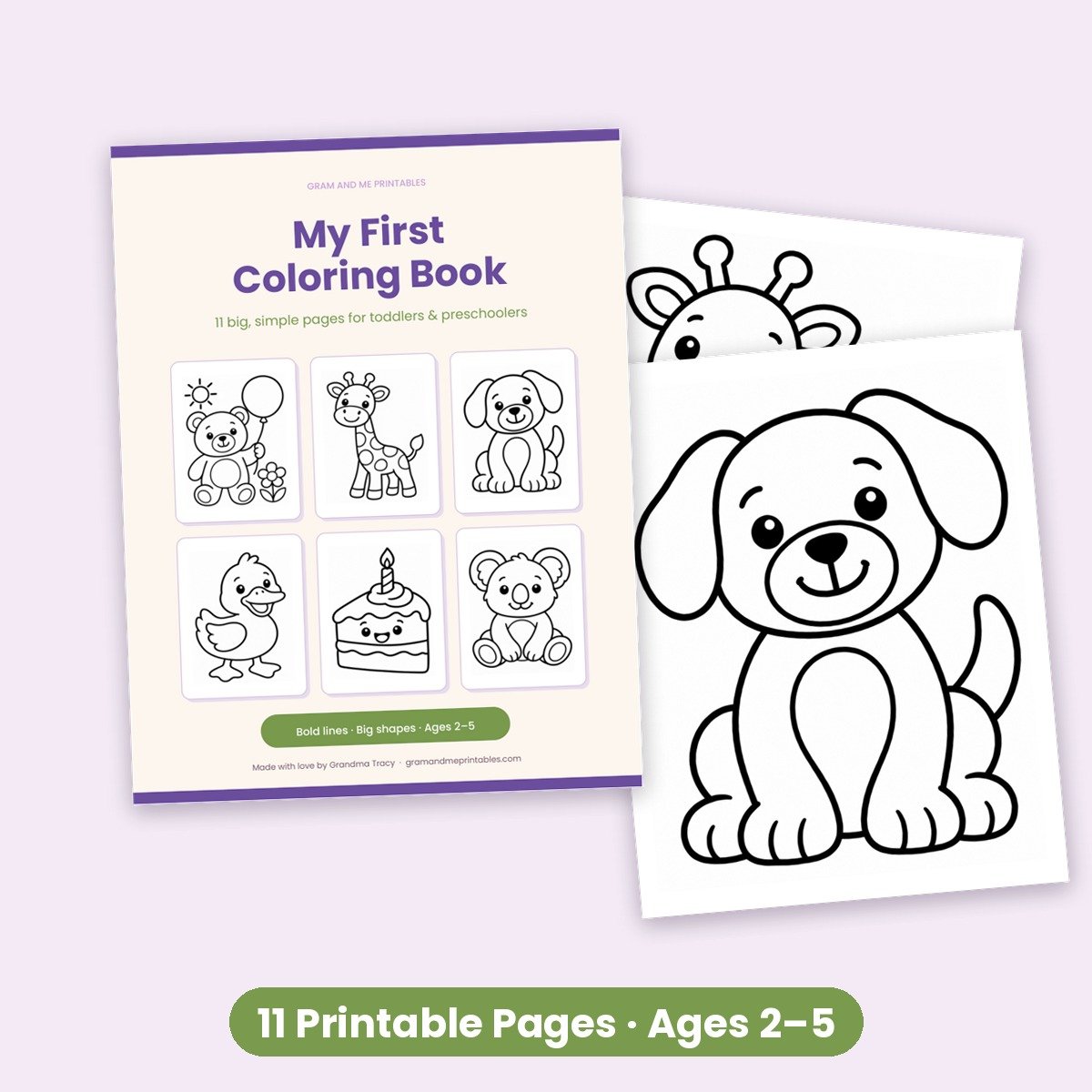
A themed set can help here, especially if an older grandchild is headed into the big school years. Our First Day of School Coloring Book offers seven pages designed for elementary students, a gentle way to talk about the big day. For the littlest ones, My First Coloring Book has 11 big, simple pages made for ages 2 to 5.

How to Print and Set Up Coloring Pages at Home
How to print and set up coloring pages at home comes down to three choices: paper weight, printer settings, and a work surface you do not mind getting crayon on.
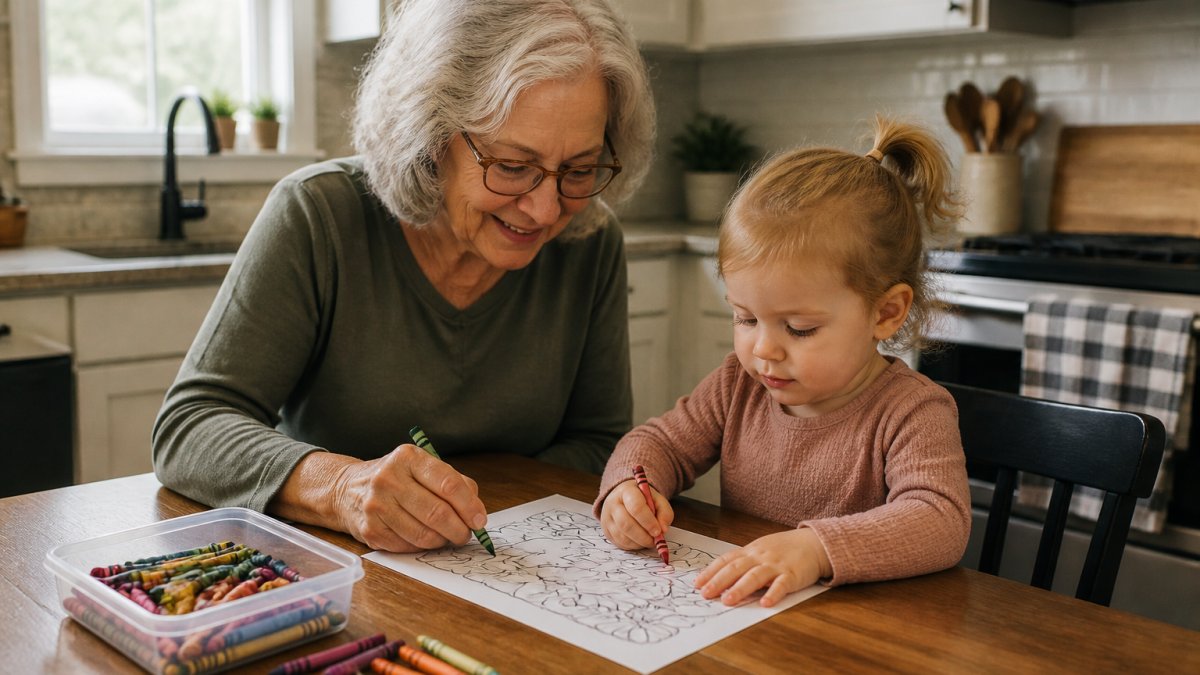
Start by opening the PDF and choosing "Actual size" or 100% scale. If your printer clips the edges of the design, switch to "Fit to printable area" instead.
Paper and Printer Settings
Paper and printer settings decide whether the page survives a toddler. Regular printer paper is fine for crayons and colored pencils; if your grandchild reaches for markers, heavier cardstock resists bleed-through.
A few settings worth checking:
- Scale: actual size or 100%
- Paper size: standard letter paper, 8½ × 11 inches
- Quality: standard is fine; draft mode can make lines look faint
If you are printing a page like our Enchanted Forest set, each sheet is designed at 7½ × 10 inches and prints on letter paper with a small white border, so nothing important gets cut off.
Supplies That Work Best for Little Hands
Supplies that work best for little hands are short, thick, and easy to grip. Chunky crayons beat thin ones, and washable markers save a lot of scrubbing.
Our short list:
- Chunky washable crayons for ages 1 to 3
- Triangular crayons to encourage a proper grip
- Washable markers on cardstock, with a protective sheet underneath
Safety and Supervision During Coloring Time
Safety and supervision during coloring time are mostly about small parts and small mouths. Toddlers explore with hands and mouths, so anything that fits in a fist needs a second look.
Keep these habits in place:
- Sit within arm's reach. You do not need to color every second, but stay close.
- Choose large, unbreakable crayons. Broken pieces become choking hazards (Small Parts Ban and Choking Hazard Labeling).
- Check the materials. Look for non-toxic, washable labels on crayons and markers.
The Consumer Product Safety Commission guidance on art materials is a helpful reference for what to look for on the label. Supervision is not about hovering. It is about being nearby enough that a toddler stays safe and you both stay relaxed.
Frequently Asked Questions
What coloring pages are best for toddlers?
Look for pages with large, simple shapes and thick outlines, like animals, vehicles, or everyday objects. Avoid tiny details or complex scenes. Toddler coloring pages should have broad spaces that are easy for little hands to fill. Themes like bears, monkeys, cars, and rockets work well because they connect to things toddlers recognize and love.
How do I print coloring pages for toddlers?
Use standard US Letter paper and set your printer to 'Actual size' or 100% scale. For crayons or colored pencils, regular printer paper works fine. If you use markers, choose heavier cardstock to prevent bleed-through. Always print a test page first, and adjust to 'Fit to printable area' if the edges get clipped. A small white border is normal and helpful for framing.
Are coloring pages good for toddlers?
Yes, coloring supports fine motor skills, hand-eye coordination, and color recognition. It also gives toddlers a calm, screen-free activity to share with a caregiver. Keep expectations realistic: most toddlers color for 5 to 15 minutes at a time. The goal is exploration and fun, not a finished masterpiece. Simple printable coloring pages for toddlers make it easy to offer this activity often.
How can grandparents make coloring time fun with toddlers?
Sit and color alongside your grandchild. Choose a theme they love, like animal coloring pages for toddlers, and talk about the pictures as you color. Use chunky crayons that are easy to grip. Keep sessions short and relaxed, and display the finished page on the fridge. For a special treat, try My First Coloring Book, 11 big, simple pages made for ages 2 to 5.
Coloring time works best when it’s easy to set up, easy to repeat, and built around the child in front of you. That’s the whole idea behind Gram and Me Printables: screen-free, print-at-home pages ready before the grandkids walk in the door.
Start with 3 free pages. Grab my Toddler Coloring Sampler and see how your little one likes it. Get the free sampler →
Ready for the whole set? My First Coloring Book has all 11 pages for $3.97.


